Game night can fall apart in five minutes. Someone opens the rulebook, starts reading “Setup” too early, and nobody knows what “winning” even looks like. Before long, you’re stuck arguing over a corner case you could have solved in the first paragraph.
The fix is simple. When you’re reading game instructions, focus on the objective and win condition right away. Once you know what success looks like, the rest of the rules click into place.
In the sections below, you’ll get a practical reading order that works for most board and card games. You’ll also pick up pro tips for finding answers fast, plus common traps that derail even good players. After this, your next rulebook session should feel more like tuning an instrument and less like guessing.
Why the Game’s Goal and Win Condition Come First
Think of the win condition as your GPS. Setup is the road map, and turn rules are the driving instructions. But if you don’t know your destination, every turn feels random.
That’s why experts push the objective first. When you read the winning condition early, you stop wasting brainpower on details that won’t matter. You also build a shared target for your group. People don’t argue as much when everyone knows what “good play” means in that game.
For example, in a resource strategy game, you might think you need to collect everything. Then you read the win condition and realize you only score for specific sets. Suddenly, the “extra” resources turn into optional side quests. Same actions, clearer priorities.
A good rulebook also connects the objective to the theme. You’ll see it in how the game explains scoring, endgame, or victory points. Stonemaier Games calls out what makes a rulebook work, including a clear path for players to learn the game without getting lost. Their breakdown fits this idea: rules should guide players toward the goal, not bury it. Read more about what makes a great rulebook here: What Makes a Great Rulebook?.
Here’s a quick way to visualize it while you read:
| Read this first | What it helps you understand |
|---|---|
| Win condition | What choices matter most |
| Endgame trigger | When to switch from “build” to “finish” |
| Scoring or tie-breakers | How the “last turns” actually work |
So even if you’re eager to start placing pieces, take a breath. Scan the win section before you touch anything. Your setup decisions will feel calmer, because you know what you’re aiming for.

Spot the Big Picture Before the Details
Once you know who wins and why, your brain starts organizing the rulebook for you. Each page stops being random text. Instead, it becomes support for the goal.
Compare two approaches:
- Objective-first reading: You interpret actions as “how they move me toward victory.”
- Setup-first reading: You interpret actions as “what do I do right now,” with no context.
Ticket to Ride and Catan feel very different, but the learning pattern stays similar. If you learn what counts as “winning” first, routes and resources make sense faster. If you skip that, you can still play, but you’ll likely play inefficiently.
Also, objective-first reading helps you notice rule writing style. Many rulebooks introduce a theme and then state the victory condition. After that, they describe actions that feed the victory condition. This is the game designer’s loop. Once you see it, the loop repeats on every page.
You can even do a tiny test on yourself. Close the rulebook for a moment and explain the win condition in plain words. If you can’t, reread that section again. Then continue.
Your first win-condition read is like learning the chorus. Everything else is just the verses.
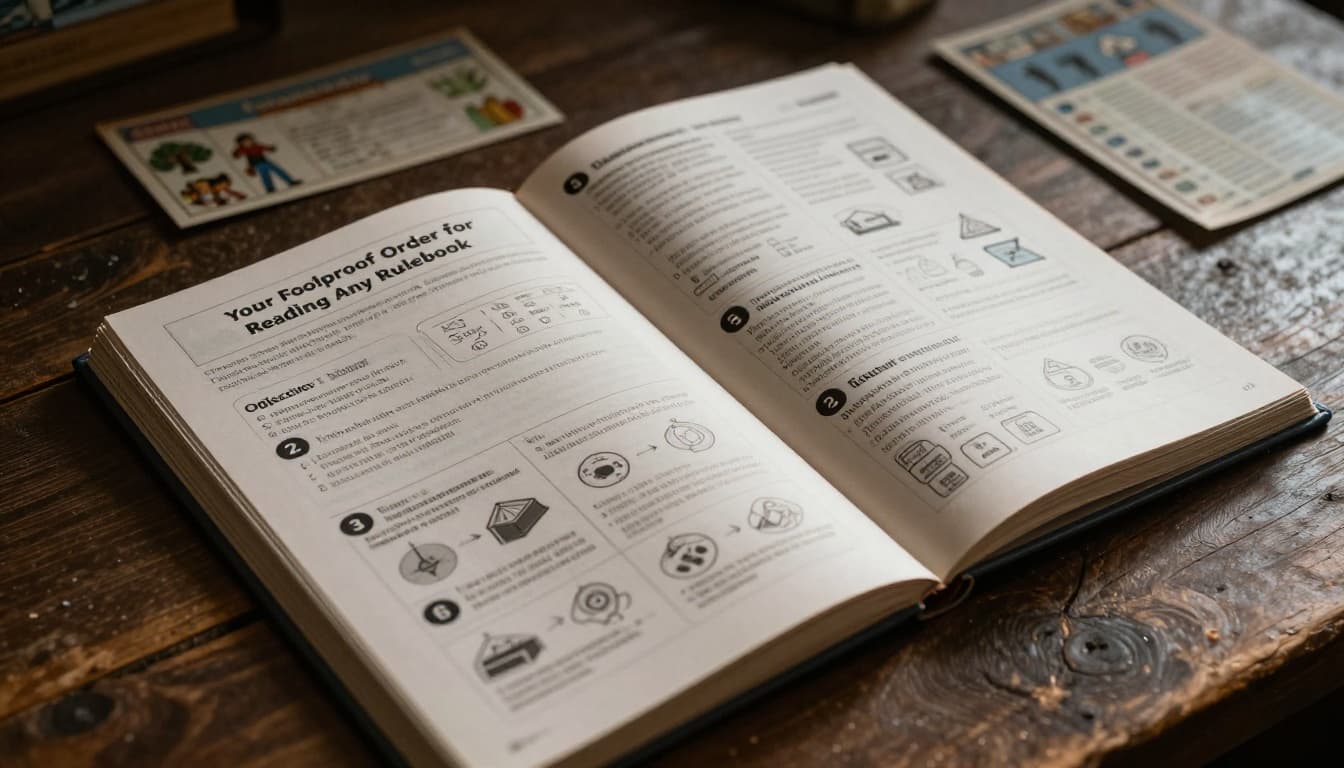
Your Foolproof Order for Reading Any Rulebook
Here’s the rule-reading flow that works for most board game rules and card game instructions. It’s built for speed, but it stays accurate. You won’t need to “read every word” to understand how to play.
Because many rulebooks now include icons and player aids, your order can also adapt. In 2026, more rulebooks aim for fast teaching with visuals and quick references. That means you can scan, then confirm with the book.
Use this order as your baseline:
- Theme snapshot (what the game is “about”)
- Win condition (how victory works, including endgame)
- Player count and time (whether it fits your group)
- Setup essentials (what you physically do first)
- Core turn loop (main actions and turn order)
- Endgame and tie-breakers (how the game ends and scores)
Now let’s make those steps practical.
Quick Theme and Objective Scan
Start with the first page section that explains the theme. Then immediately move to the objective and winning conditions.
Don’t hunt for tiny exceptions yet. Just look for the “main statement.” Ask yourself:
- What action leads to points, control, captures, or survival?
- When does the game stop?
- What breaks ties?
Then reread the win condition once more. The second pass is where you catch weird phrasing. Also, it helps your group avoid “half-understood victory” later.
If the rulebook is dense, use structure. Card Game Authority breaks down how to read game rules by focusing on the legal play parts first, then moving into details. Their approach is especially useful when you feel overwhelmed by wording. Here’s a helpful guide: How to Read and Understand Card Game Rules.
Good rulebooks usually make the objective easy to spot. You might see it in:
- a box titled “Goal”
- a short victory summary near the start
- a scoring section that lists point sources
Bad rulebooks hide it in the middle. If that happens, treat it like a treasure map. Go straight to the “end of game” and “scoring” parts next. Then return to the start.
One more trick: translate the goal into a single sentence. Example: “I win by earning the most points when the game ends.” If you can say it simply, you can plan.
Player Count, Time, and Setup Essentials
After you know the objective, check if the game matches your night.
First, scan the sections for:
- number of players
- play time
- what components are needed
This is where you avoid awkward surprises. If your group has six players, but the rules say four, you’ll feel it mid-game. Also, some games have different setup per player count.
Next, focus on setup like a pilot preflight. You’re not memorizing every card name. You’re learning what you must do before the first turn.
Use the setup section to answer three questions:
- What goes on the table, and where?
- What do players start with?
- What order do we follow during setup?
If a rulebook includes an example setup diagram, use it. In 2026, visuals and player aids really matter. Many publishers use icons and flow charts to reduce guesswork.
Then, during actual setup, follow the steps in order. Don’t “improvise” until after one full round.
If your goal is a smooth night, the best setup move is to keep it simple. Get the table ready, then start playing. Rules get easier once you see pieces in motion.
For quick cross-checks, you can also search for the game’s rules reference. TheRuleBook has a growing library of how to play guides. It’s handy when you want to confirm a rule section fast: TheRuleBook – How to Play Any Board Game.
Core Gameplay and Endgame Triggers
Now you’re ready for the heart of the game: the core gameplay loop.
Scan for:
- turn order (who goes, and what “round” means)
- main actions (move, draw, build, trade, attack, etc.)
- how effects resolve (order matters)
Most rulebooks include a short “how a turn works” section. Find it and read it slowly once. Then do a “dry run” in your head. Imagine your next turn. What would you do first? What would you do next?
After that, jump to the endgame parts. You’re looking for triggers like:
- deck runs out
- a track hits a marker
- a set of objectives completes
- a time limit is reached
Also check how scoring and tie-breakers work. This is the part people forget. Then they act surprised when the game ends and their points don’t match their plan.
If you want an efficient strategy for learning fast, Playiro’s guide focuses on reading rules quickly by getting the big picture first, then checking how the game plays in practice. It also stresses working through the rulebook in an order that prevents confusion. You can see their tips here: How to Read and Understand Game Rules Quickly.
Finally, accept that you can be flexible. Heavy games might need more time. Light party games might need less. Your job is to understand the loop, then adjust as you play.
Pro Tips to Decode Rules Like a Veteran Player
Once you know the order, you need tactics. These habits make rule reading feel less stressful and more productive.
Here are veteran-style moves you can use tonight:
- Skim headings and icons first: Titles tell you what matters. Icons tell you when to stop guessing.
- Look for “example of play”: Examples show the rule in motion. That saves you from interpreting phrasing.
- Check the glossary terms early: If a rule uses a defined word, read its definition before continuing.
- Act out one full turn: Don’t stop at “I get it.” Make a move and confirm the outcome.
- Teach the rule back out loud: Say it like you’re coaching a friend. You’ll catch your own holes fast.
- Play the first round with “minimum risk”: Avoid big commitments until you see how resolution works.
The most important idea is this: rulebooks are not novels. They’re legal instructions. You don’t need to feel the vibe. You need to run the loop correctly.
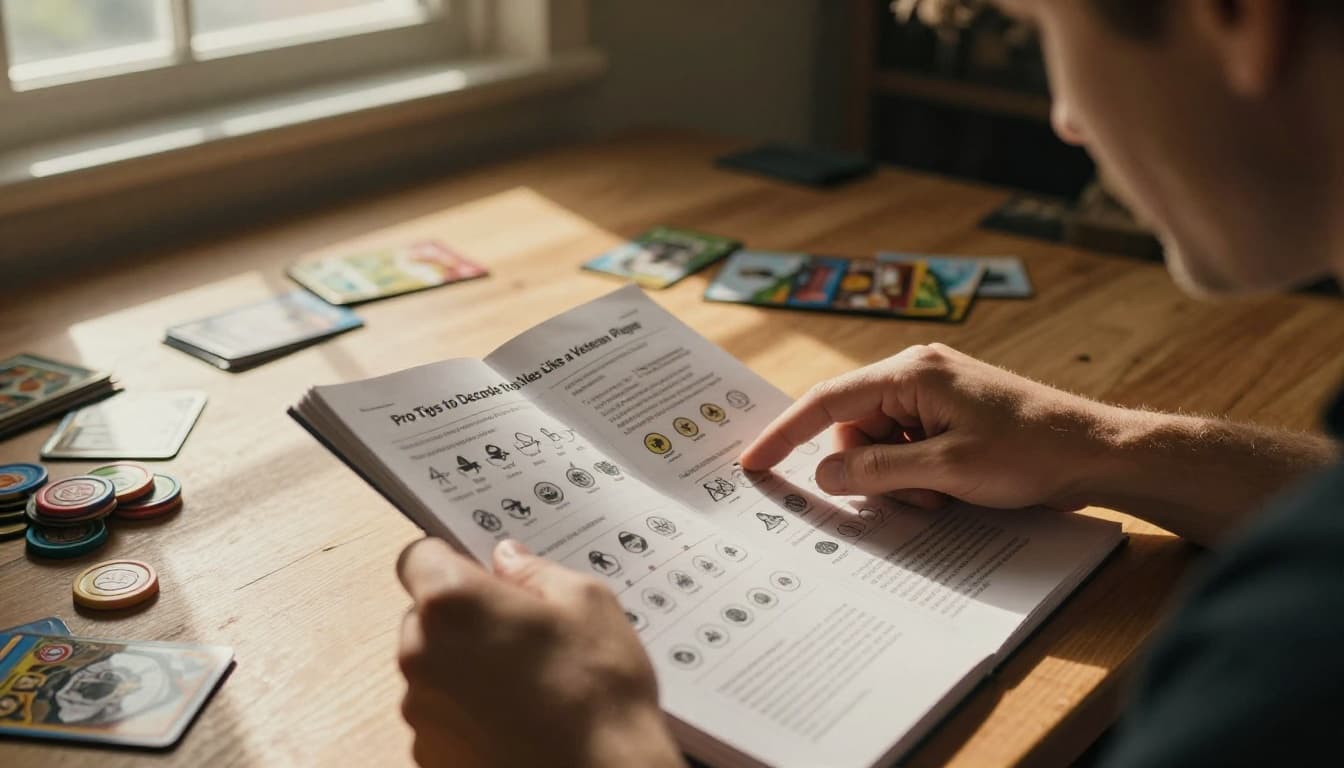
Hunt for Examples and Icons Every Time
Examples and icons are like subtitles. Without them, you think you understand. With them, you realize exactly how actions resolve.
When you find an icon key, use it as you read turns. That way, you avoid the “wait, does this arrow mean move or attack?” moment.
Examples are even better. A sample turn often shows:
- what cards you draw first
- which effect resolves before another
- how players place pieces in sequence
Even if the example uses different board states, the rules stay the same. So you’re not “spoiled” on strategy. You’re learning the rules.
If you want a simple habit, try this:
- After you finish reading a section, find one example.
- Match the example steps to the rule text.
- If they don’t match, mark the conflict and revisit.
Your goal isn’t perfect memorization. It’s correct resolution.
Dodge These Common Rule-Reading Traps
Even careful players fall into the same traps. Usually, the group doesn’t notice until the game punishes the misunderstanding.
Here are the most common ones, and how to fix them fast:
First, detail-diving too soon. If you read every exception before you understand the goal, you lose time and focus. Skip exceptions until after your first round.
Second, ignoring icons and examples. When a rulebook uses symbols, it’s telling you how to interpret the page quickly. If you ignore that, you’ll misread actions.
Third, skipping endgame and tie-breakers. This is where victory surprises happen. Always scan “end of game,” even if you feel eager to start.
Fourth, group mismatch. Some games don’t fit certain groups. If your group hates math-heavy scoring, but the rules force lots of counting, you’ll feel frustration. Check player count and learning curve before setup.
Lastly, playing house rules without agreement. If you start “doing what makes sense,” your group might not share the same interpretation. Agree on the official rules before you play.
If you want proof that these mistakes happen often, BoardGameGeek threads collect common rules errors people make. It’s useful when you want to sanity-check your assumptions: common rules mistakes on BoardGameGeek.

Conclusion
Game night doesn’t need to start with panic. When you focus on reading game instructions in the right order, the rulebook stops feeling like a puzzle box.
Start with the objective and win condition. Then move through player fit, setup essentials, the core turn loop, and finally the endgame triggers and scoring details.
Next time someone grabs the rulebook, try the objective-first approach. Then ask your group to explain how they win in one sentence.
What’s the worst rulebook moment you’ve had, the one that turned “fun” into “wait, what?” Share it, so other players can dodge the same trap next game.